The Work, Not the Spectacle: Simon Turney's "Agricola: Commander"

Simon Turney’s Agricola: Commander arrives at a point of confidence, settling into productive tension—between the machinery of conquest and the cost of operating it, between what the sources tell us and what they leave conspicuously silent.
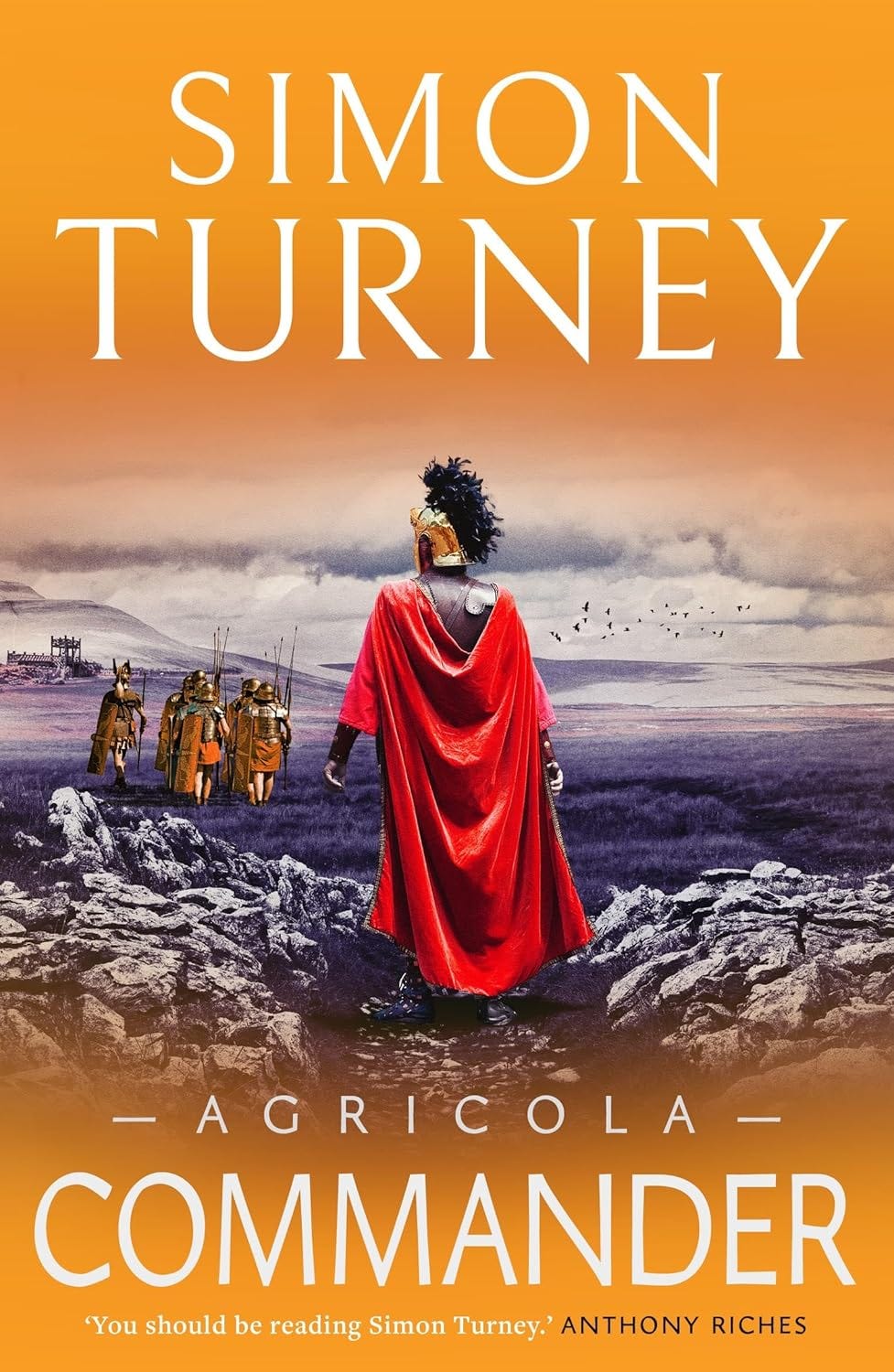
Set during Rome’s consolidation of Britain (AD 69–73), the novel opens amid post-civil war instability. Agricola—historical legate, future governor, reluctant politician—must restore order to a nearly mutinous legion. From there, Turney builds something double-edged: the external campaign against the Brigantes mirrors Agricola’s internal struggle to learn when to command, when to yield, when to disappear into his superiors’ shadows.
Turney’s historical method is sincere. Real figures—Bolanus, Cerialis, Cartimandua, Venutius—move through the narrative weighted by documentary evidence, but he doesn’t pretend the sources are complete. He stitches Tacitus and Statius together with admitted conjecture and lets contradictions stand.
Invented characters in historical fiction often exist only to explain what people in that time wouldn’t need to be explained to each other. Luci Julius—Agricola’s Silurian bodyguard—could easily have fallen into this trap. Instead, Turney makes him the book’s moral center. His weary humor and divided loyalties don’t just provide color; they force the question the novel keeps circling: what does it mean to survive empire when you were supposed to resist it?
Battles appear when they reveal consequence rather than demonstrate spectacle. When combat does arrive, it’s rendered with precision through logistics, terrain, and supply routes—not to showcase research, but because these constraints determine what the wars demand of the men who fight them. The prose itself mirrors this discipline: no embellishment of violence, no sentimentalizing of resistance.
In this installment, Agricola’s measured pragmatism replaces the reckless heroism of earlier commanders, and the narrative itself reflects that maturity. It’s a story about patience, about the unglamorous labor of building stability after chaos. The political awareness—who gets credit, who takes blame—feels particularly sharp. Agricola understands that glory belongs to the governor, and his success depends on keeping his head down and out of the light.
What Turney offers here is Rome’s advance stripped of triumphalism—conquest as endurance and the unglamorous work of stabilization after chaos. The novel trusts its readers enough to sustain a story built on patience rather than spectacle, and the result is his most disciplined work in this series yet.
This review is of an advance reader’s edition provided by NetGalley and Head of Zeus | Aria & Aries. It is currently scheduled for release on December 4, 2025.